
Innovation
A technological shift, like Goliath Gel for cockroaches
In pest control, some innovations do not merely improve practice: they transform it.
There was one in the late 1990s. There is one today, and it no longer concerns cockroaches.
To understand what is shifting in mouse control, it is worth taking the detour through cockroach gel. Not out of nostalgia, but because the mechanism is exactly the same.
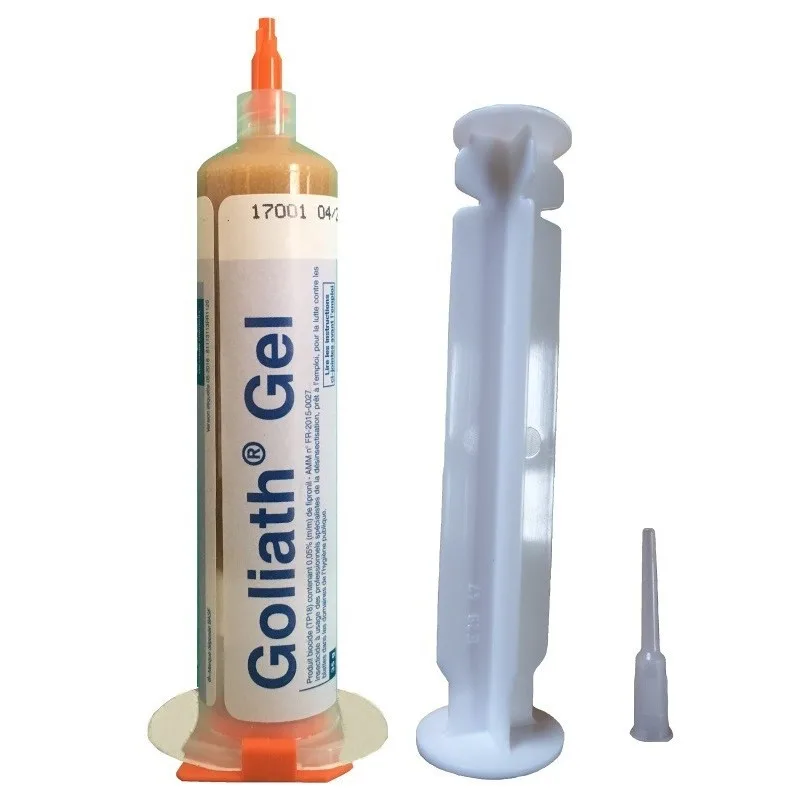
Gel applied with a syringe: a few spots were enough where a whole room had to be treated before.
Before the gel: spraying and everything that came with it
Treating a kitchen against cockroaches was an operation. Worktops had to be cleared, food protected or taken out, staff kept away, then spraying, then the room closed for several hours before airing it and putting everything back.
The client, meanwhile, closed. The appointment was set for the night or the day off, the smell lingered, and it often had to be done again a few weeks later. The problem was not the insecticide: it was everything the insecticide imposed around it.
What the gel changed
In the late 1990s, Goliath Gel transformed cockroach control. No more heavy, demanding spraying: professionals discovered a targeted, discreet and radically effective solution.
A few spots laid down with a syringe, where the cockroaches travel, and that was it. No room to evacuate, no service cancelled, work possible with staff present. The gel then passed between individuals, including those never seen.
The trade changed pace. The job became short, clean, repeatable, and above all acceptable to the client. Those who adopted it first gained a lasting lead.
The lesson I took from it
In the field, I saw how a disruptive technology can transform a company and a trade. Not just the results: the organisation, the pricing, the relationship with clients, right down to the pride taken in the work.
A real shift is not recognised from its spec sheet. It is recognised by what it removes: a constraint everyone had ended up accepting as normal. And at first it always unsettles people, because it costs more to buy and forces habits to change.
Where mouse control stands today
Traditional methods are reaching their limits, and everyone sees it on their own sites. Anticoagulant resistance is documented, bait refusal is frequent, and a partly eaten block tells you neither how many animals passed through nor how many died.
On the client's side, there is nothing to show. Carcasses stay in the wall cavities, the smell arrives two weeks later, and the end-of-visit conversation rests on your word rather than on a result. On sites subject to audit, that lack of proof is expensive.
Regulation, meanwhile, is tightening around rodenticides, and permanent baiting is increasingly hard to justify. As for conventional mechanical traps, they catch one mouse, then wait for someone to come and reset them.
The parallel with 1998 is striking: it is not the product that holds things back, it is everything the product imposes around it.
What sets Mirabox apart from other traps
After 27 years in the field, I designed Mirabox: a patented automatic trap, robust and hygienic. What separates it from other traps comes down to three points, and all three follow from the behaviour of the mouse.
It intercepts instead of waiting. A conventional trap assumes the mouse will take an interest in the bait, accept this new object and choose to go in. Mirabox is set on the identified travel routes and takes the animal as it moves about naturally. We do not ask it to change its behaviour: we stand in its path.
Nothing to climb. Its two entrances are at floor level, with no step and no ramp. Many devices force the rodent to climb, to enter a narrow tunnel or to cross a threshold: so many chances to turn back, especially in a wary animal. Here it carries straight on along the wall, as it would have done without the trap.
The result is immediate. Captures come from the first night: no settling-in period, no delay in action as with a bait. And the trap keeps working between visits, with no resetting after each capture.
To that, mechanics add their own advantages: no biocide, so no possible resistance, and a closed container compatible with the hygiene requirements of a kitchen or a workshop.
Above all, no more missing carcasses and sceptical clients: the proof is visible in the box. Captures are shown, counted, and turn a matter of opinion into a shared observation.
How to recognise a real shift
It removes a constraint instead of improving a product. The gel was not a better insecticide: it removed the need to close the room.
It changes how the work is organised: how long a visit takes, how often it happens, when it happens, what is handed to the client at the end.
It moves value towards whoever knows how to use it. A breakthrough used carelessly gives nothing; used well, it sets a company apart from its competitors for years. That is also why Mirabox stays reserved for professionals.
Being among the first
Technological shifts are rare. They separate those who follow from those who lead.
In 1998, no one could prove the gel would prevail. Those who tried it first were not taking a risk: they were taking a lead, and they kept it for several years.
The same moment is here today in mouse control. To see Mirabox at work on one of your sites, write to us: we reply to pest control companies, and to them alone. You can also start by seeing how it works.