Field
Sizing up a mouse population: field benchmarks
On site, many clients overestimate the number of mice.
A single mouse can produce close to 50 droppings in 24 hours. When you see them everywhere, you picture an invasion.
The question “how many are there?” comes up on every job, and the answer given by eye is almost always wrong, in one direction or the other. Here are the benchmarks that let you size up a mouse population instead of guessing it.

Why the number of mice is almost always wrong
The client counts the signs. They see droppings in three cupboards, a smear along a skirting board, a chewed bag, and conclude there is a colony. But a single mouse covers several dozen square metres every night and leaves droppings all along its routes: the signs multiply far faster than the animals.
Conversely, the person who says “I saw one” almost always underestimates. Mice are discreet and active at night, and the ones seen during the day are often the youngest or the most pressed, pushed out by competition. Spotting one in the middle of human activity usually signals a population already established.
Both errors come from the same place: judging an invisible population from traces, with no method to turn them into a number of animals.
With bait, you measure nothing
With anticoagulant products, you never know what is happening: bait is sometimes eaten, sometimes not, and it always feels as though the problem will never end.
Consumption says very little. A partly eaten block may have been visited by one animal or by ten. An untouched block may mean there are no mice left, or simply that they prefer the flour in the next aisle. And an animal that dies does so elsewhere, in a duct or a wall cavity, never appearing in any count.
The result: the job stays open. You come back, you refill, you still find signs, and you can never tell the client where the population actually stands, nor when it will be over.
Three benchmarks for sizing up a mouse population
The 48-hour count. Clean an area completely, then come back two or three days later. What has reappeared matches current activity, not the history of the room. At 50 to 80 droppings per mouse per day, around a hundred fresh droppings in two days is still consistent with a single animal; several hundred is not.
How the signs are spread out. One heavily marked route usually means a localised presence. Signs in distant rooms, on different floors or on either side of a busy area point to several nests. A mouse has a small territory: it does not work both ends of the building.
How quickly activity resumes after the first captures. If activity stops dead after two or three captures, the population was small. If it picks up again at the same rate over the following days, there are more left, probably many more. It is the only one of these three benchmarks that gives a verifiable figure.
These benchmarks are read from the signs described in our article on droppings, smears and noises.
What a real capture changes
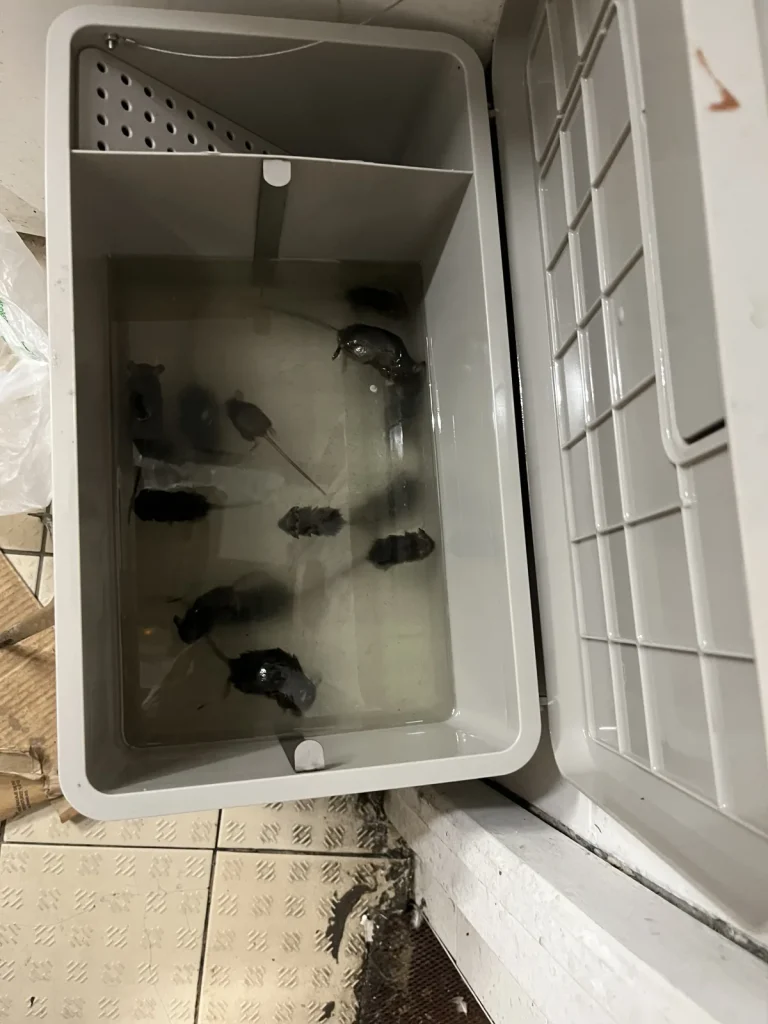
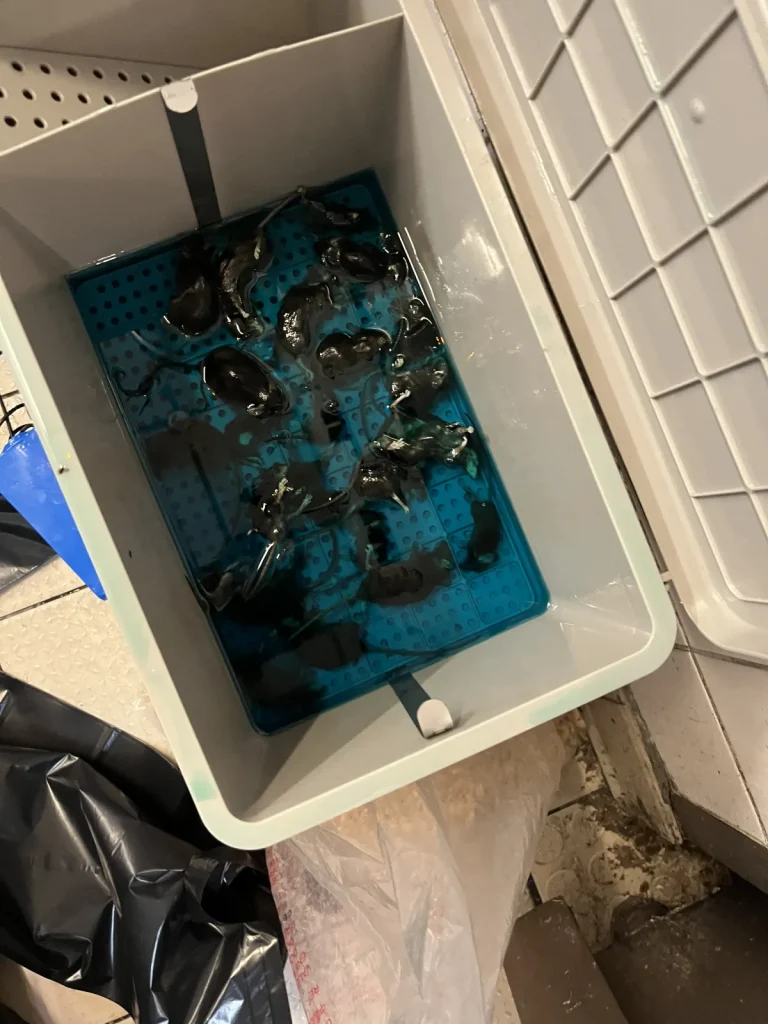
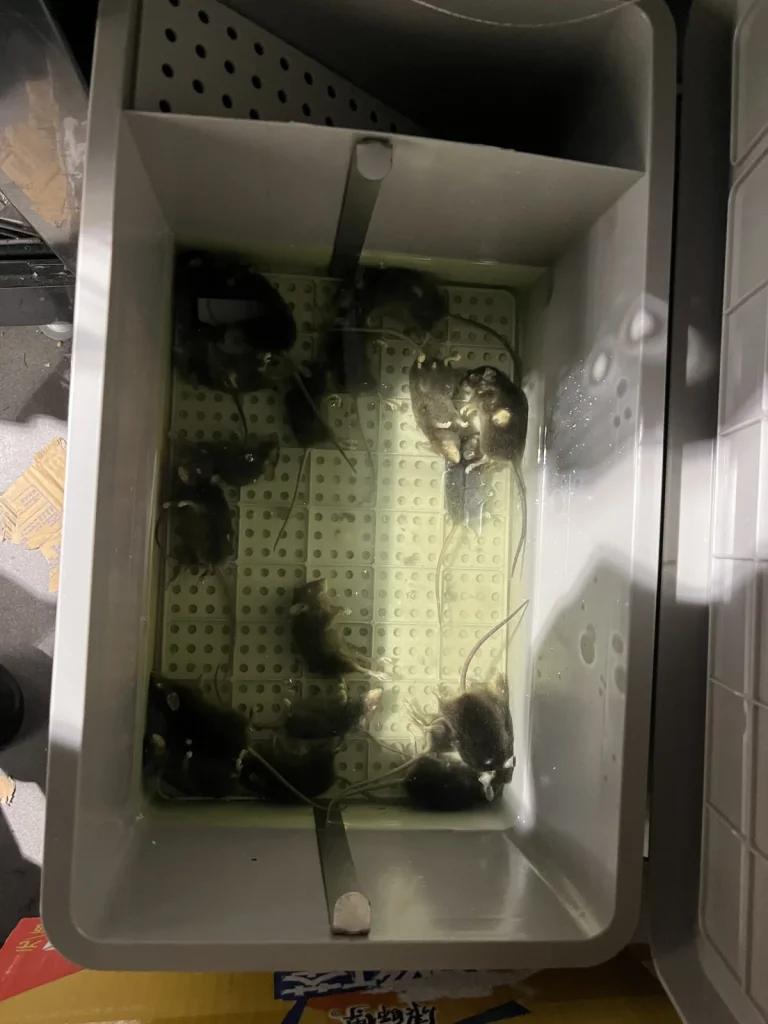
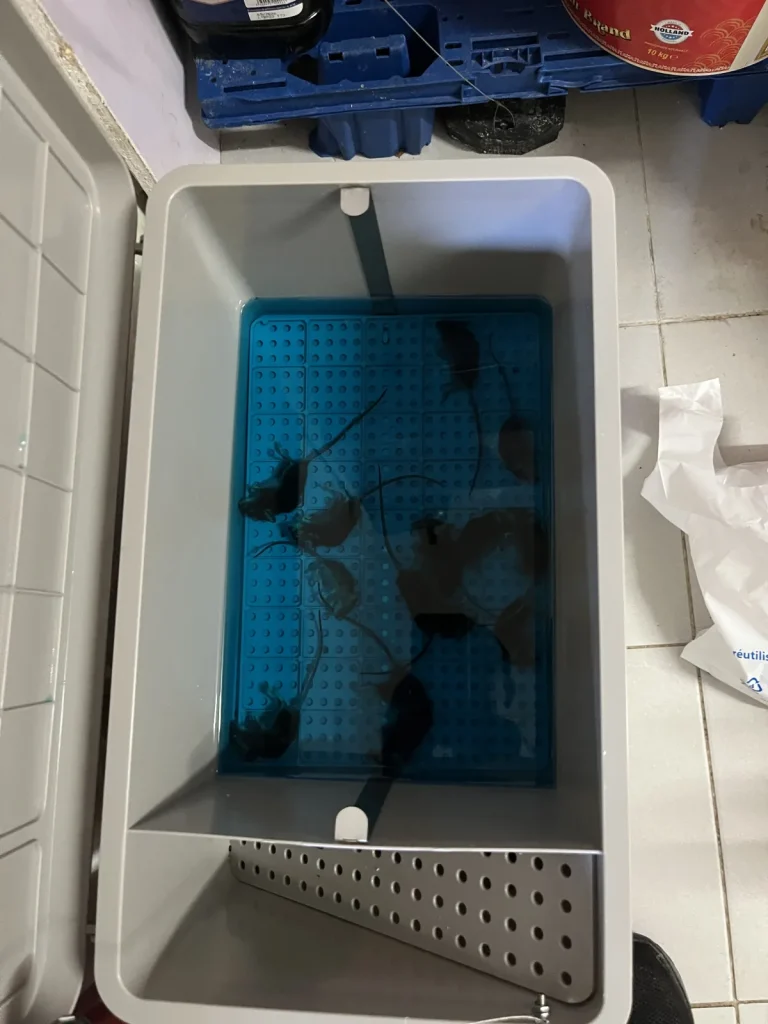
But when you capture 20 or 30 real mice, everything changes: no more droppings, no more odour, no more traces.
The result is visible, measurable, concrete. And clients feel it immediately: complete satisfaction.
A capture is a fact. It is counted, dated, photographed. There is no more arguing about whether it works: you show twenty-eight mice captured in three weeks, then two the following week, then none. The curve tells the story better than any report.
For the technician, those figures feed the hygiene file and the audit. For the client, they replace worry with information.
What really counts is speed, not arithmetic
Sizing up a population serves a decision, not a statistic. And the decision is always the same: move fast. A female gives birth after three weeks of gestation, five to six young on average, and those young breed in turn two months later.
In other words, a population misjudged today is not only poorly known: it will be different in three weeks. Every week spent observing, dosing and coming back gives a litter time to arrive.
Counting is proving
That is exactly what Mirabox brings: not another estimate, but real captures, from the first night, on the routes you identified. The trap does not contain an infestation over time, it resolves it, by leaving the mice already there no time to breed.
And along the way it answers the opening question. How many were there? The answer is no longer an impression: it is a number.
The photos below were taken on site, on Mirabox traps checked at clients' premises. This is what a real count looks like: mice you can show and count.